
Share
Share
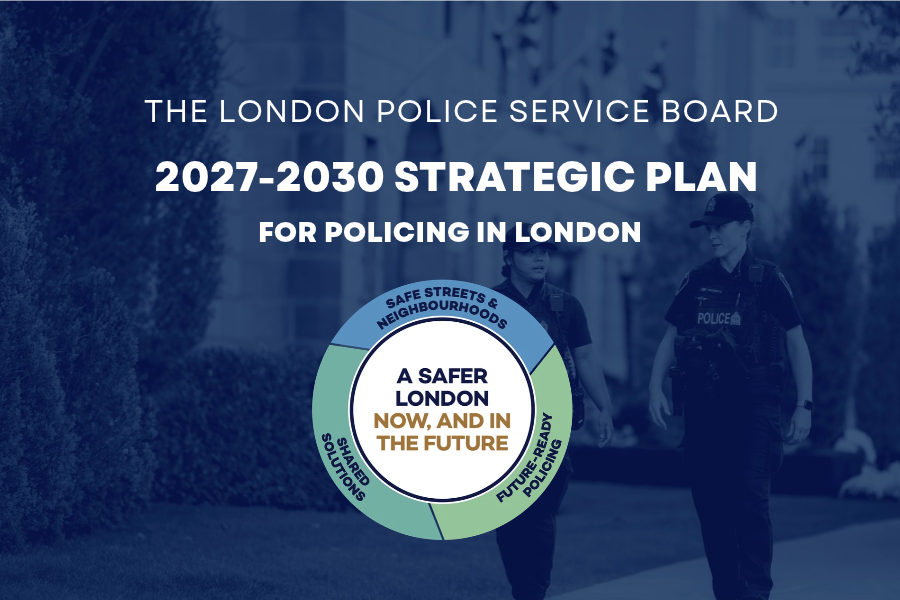
The Board’s 2027–2030 Strategic Plan for Policing (the “Plan”) brings together what Londoners told the Board about safety and policing in their communities and the experiences of members of the London Police Service (the “Service”), whose readiness and well-being shape the service this community receives, with a path to adapt as policing pressures evolve.
The Board sets the strategic direction and holds the Service accountable.
The Chief leads the Service in implementing the Plan.
The guiding purpose:
A Safer London Now, and in the Future.
Why a New Plan Now?
London is a diverse and growing city, and the public-safety pressures it faces are increasingly complex. Rather than wait for the current 2024-2027 Plan to end, the Board determined that London would be better served by a new four-year Plan, informed by community input and the realities of current and future public safety needs.
The Plan brings this into one coordinated, measurable direction and provides a stronger foundation for understanding future resource requirements.
Ontario’s Community Safety and Policing Act, 2019 (CSPA), also sets expectations for strategic planning, performance measurement and long-term resource planning, which are reflected in the Plan.
What We Heard, and How It Shaped the Plan
The Plan’s direction starts with what we heard from Londoners.
Advanis, an external research firm, conducted a randomly recruited survey of 1,102 London residents, ten focus groups and two public input sessions. The process also included public submissions, direct correspondence, and ongoing community engagement, along with the results of a Board-led internal survey. The Board considered the input with the understanding that the quality of service the community receives is directly linked to organizational health and the preparedness and well-being of the membership.
The independent survey established a broad picture of community priorities, while focus groups and public discussions helped the Board understand the experiences behind those findings. Board and Service representatives did not attend the focus groups, so participants could speak openly and candidly.
Across the consultations, people reinforced that they want to feel safe in their neighbourhoods, homes, and in public spaces. They want timely help when they call the police, meaningful follow-up, and confidence that police are effectively preventing, enforcing, and investigating crime. Trust, confidence, and communication about police actions and results were also recurring themes.
Londoners also called for better coordination on complex social challenges, with the right response from the right service at the right time, meaning police involvement where their role is essential, and other supports where they are a better fit. Many situations police encounter involve people experiencing mental health or substance use challenges, housing insecurity, or other vulnerabilities.
Policing alone cannot resolve the circumstances that often bring people into repeated contact with police. Until appropriate services and resources are available, police will continue to respond in situations where others may ultimately be better placed to help.
The Board’s approach reflects that balance: policing must remain strong and responsive, with support for coordination where different expertise or shared action can produce better outcomes.
Three Priorities, One Direction
These findings, together with crime trends, operational information and member feedback, shaped three interconnected priorities. They work together as one direction for policing in London. The priorities move from immediate safety to shared responses where policing alone is not enough, to the people and resources that sustain both.
The Plan is built around these three priorities, with six objectives under each. Five measurable, intended outcomes are tied to each objective, so the Board and the public can assess progress as the Chief implements the Plan.
Safe Streets and Neighbourhoods addresses public safety needs while building public confidence through responsive policing, appropriate police presence, and effective crime prevention and enforcement. The aim is for Londoners to feel safer, receive timely and effective help when they call, and trust the people who serve them.
Shared Solutions addresses challenges that policing alone cannot resolve. It focuses on coordinated responses, stronger partnerships, prevention, diversion and appropriate alternatives to police involvement, where available.
Future-Ready Policing starts with the members who put this Plan into action every day. Londoners said they want a skilled, supported and properly resourced police service, and delivering one depends on a healthy, capable workforce. This requires accountable, responsible planning for the staffing, facilities, technology, and other resources policing will need as the city grows.
What Happens Next?
Adopting the Plan sets the direction, and the next step is turning that direction into defined actions, resources and measurable results.
While Strategic direction and ongoing monitoring rest with the Board, the Chief is responsible for implementation.
The Plan takes effect January 1, 2027. The Chief will present an Implementation Plan to the Board in the second quarter of 2027, identifying the actions, responsibilities, timelines and resources to deliver the outcomes. As part of this, a Performance Measurement Framework will set measures, baselines, reporting schedules and targets, where appropriate.
Mid-year and year-end performance reports will go to the Board to assess what is working, where challenges remain and whether to adjust the approach. Year-end results will also inform the Board’s Annual Report and public reporting, distinguishing results within the Service’s responsibility from shared outcomes that partners also influence, without reducing the Service’s accountability.
The Board has also set five governance priorities as part of its oversight role: accountability, financial stewardship, responsible innovation, community trust and transparency, and collaboration and advocacy.
The Board’s responsibility does not end with adopting the Plan. Over the next four years, it will consider what the measures and evidence show, and what people are experiencing. The Board will monitor whether Londoners are seeing progress in their communities, whether members are supported and ready to deliver the Plan, and whether the approach needs adjustment.
The 2027–2030 Strategic Plan for Policing in London is available at: The Board’s Strategic Plan
The London Police Service Board has published the 2025 Annual Report of the London Police Service, providing Londoners with a clear account of policing performance, community safety initiatives, financial stewardship, and progress on the Board’s 2024–2027 Strategic Plan.

Your feedback and ideas will help the LPSB better understand the community needs, values, and expectations for policing.

As we recognize this bicentennial year, it is also an opportunity to reflect on how public safety and community governance have evolved alongside the city we all call home.

Over the past year, the London Police Service Board advanced key public safety priorities, strengthened its governance foundation, increased visibility of Board initiatives, and supported an accountable and transparent approach to oversight.
